Cao Dai Temple (Tay Ninh Holy See): Day Trip Guide 2026 | Tips for Muslim Visitors
The Cao Dai Temple – officially the Holy See of Tay Ninh (Tòa Thánh Tây Ninh) – is the mother temple of Caodaism, a faith founded in southern Vietnam in 1926 that blends Buddhism, Taoism, Confucianism and Christianity. It stands about 100 km north-west of Ho Chi Minh City, a 2.5–3 hour drive, and is usually visited together with the Cu Chi Tunnels. Entry is free, the grounds are open daily, and most visitors time their visit for the 12:00 noon ceremony, which you watch quietly from the upper gallery. For Muslim travellers it is a cultural visit only: you observe, you do not take part, and there is no certified-halal restaurant nearby, so lunch needs planning.
Status (checked October 2026): open every day with four daily ceremonies at 6:00, 12:00, 18:00 and 24:00; free entry. Visitors may watch the noon ceremony from the gallery. During major festivals the temple is very crowded, and parts of the grounds may be closed to tourists.
Cao Dai Temple: Quick Answers (2026)
| Where | Holy See, Pham Ho Phap Street, Hoa Thanh area, Tay Ninh province – about 100 km from Ho Chi Minh City |
|---|---|
| Entrance fee | Free |
| Ceremonies | 6:00, 12:00, 18:00 and 24:00 daily; visitors watch the 12:00 ceremony |
| Time needed | 1–1.5 hours (a full day with Cu Chi Tunnels) |
| Dress code | Shoulders and knees covered; shoes and hats off inside |
| Muslim-friendly? | Yes, as a respectful observer; no participation expected |
| Halal food | None verified nearby – packed halal lunch or vegetarian, arranged in advance |
| Nearest mosques | Saigon Central Mosque and Al Rahim Mosque in central Ho Chi Minh City |
| Links | Google Maps · Wikipedia |
Is the Cao Dai Temple Muslim-Friendly?
It is a living place of worship of another religion, so the honest answer is: it is welcoming and respectful, but not a place to pray or eat. Tour groups of every faith visit daily, nobody asks visitors to bow, light incense or join in, and staff in white robes simply guide you to the visitor areas. Many Muslim visitors enjoy it as a lesson in Vietnam’s religious diversity; others prefer to admire the façade and the colourful towers from the courtyard, and that is perfectly fine – entering the hall is optional. Women in hijab, long sleeves and long skirts or trousers are exactly what the dress code asks for. Shoes come off at the door, so wear socks or easy slip-on footwear.
The Cao Dai Temple in 60 Seconds
- 1926: Caodaism is officially founded in Tay Ninh; its name means “High Tower”, a poetic word for God.
- 1930s–1955: followers build the Great Divine Temple largely by hand, with donations and volunteer labour; it is inaugurated in 1955.
- The symbol: the Divine Eye – a single left eye inside a triangle or over a globe – appears above the altar and on the façade.
- The saints: a mural at the entrance shows Sun Yat-sen, Victor Hugo and the Vietnamese poet Nguyen Binh Khiem, three of the faith’s honoured spirits.
- Today: the Holy See is the centre of a faith with followers across southern Vietnam and the Vietnamese diaspora.
What You Will See
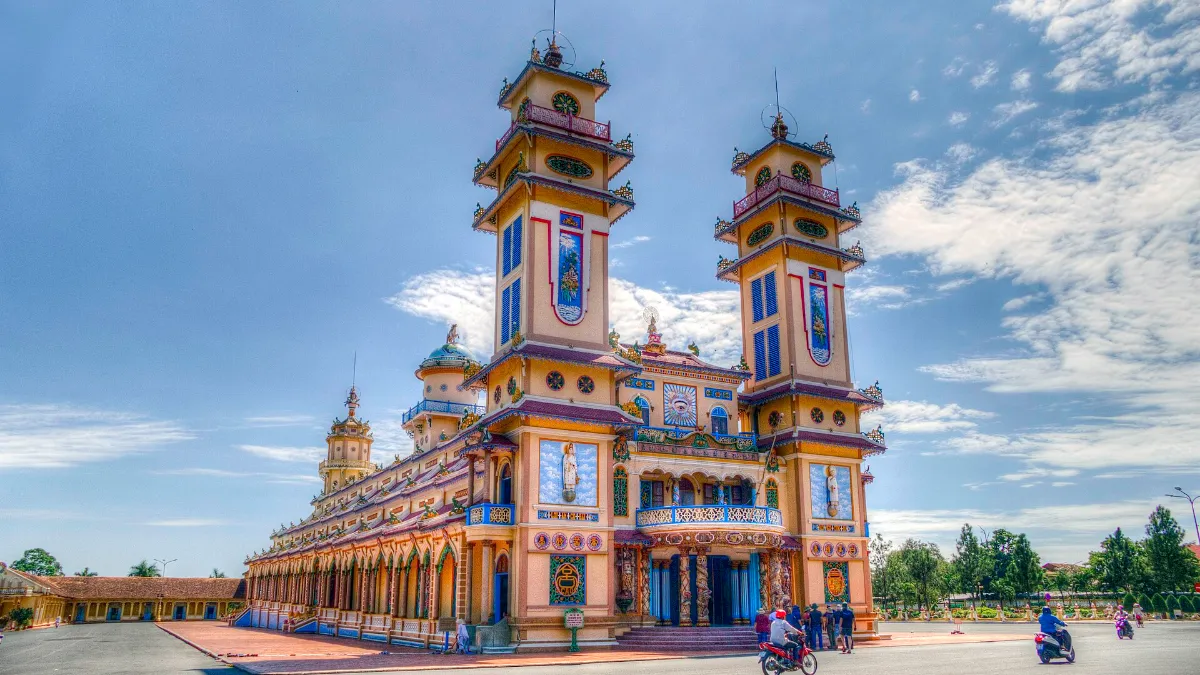
The Façade and Twin Towers
A riot of pastel pink, yellow and blue, the front of the temple rises into two bell and drum towers. Statues, lotus motifs and the Divine Eye make it one of the most photographed religious buildings in Vietnam.
The Great Hall
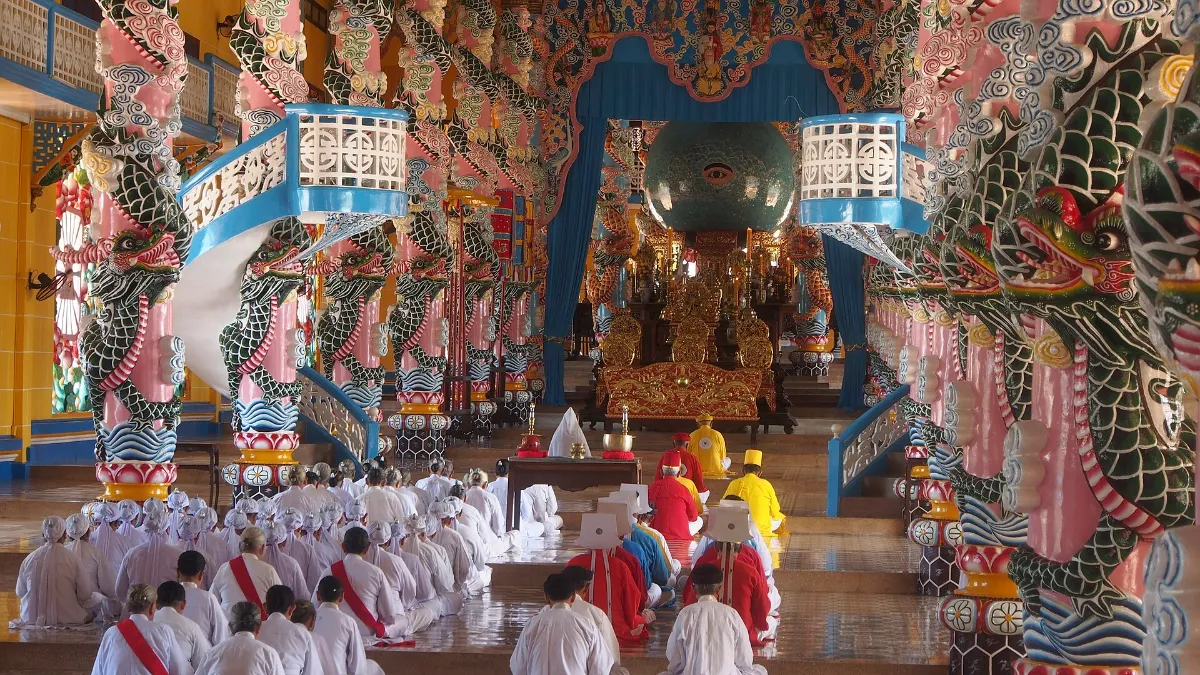
Inside, two rows of columns wrapped in sculpted dragons lead towards a huge globe painted with the Divine Eye. The sky-blue ceiling is dotted with stars, and the floor rises in nine levels towards the altar, symbolising the steps to heaven.
The Noon Ceremony
At 12:00 hundreds of followers in white robes – with dignitaries in red, blue and yellow – file into the hall and kneel in neat rows while musicians and a choir perform. Visitors watch in silence from the upper gallery for about 20–30 minutes. Arrive by 11:30 to find a place.
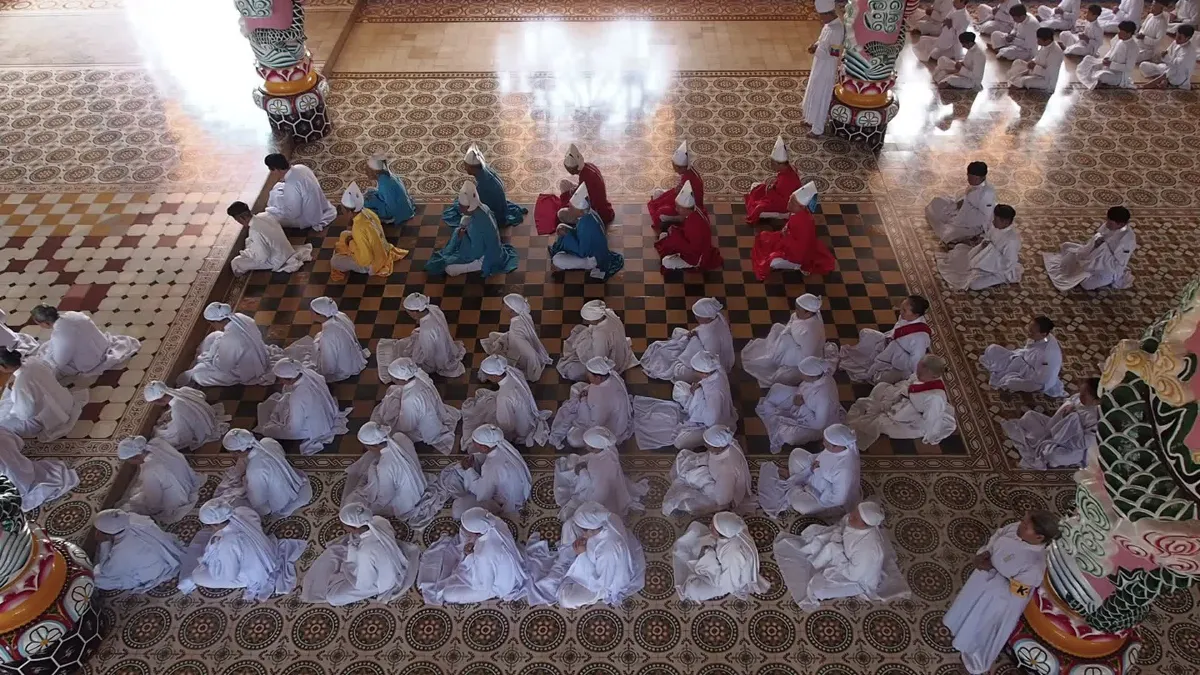
The Gardens and Holy See Complex
The temple stands in a walled complex of gardens, administrative buildings and tree-lined avenues. It is a peaceful place for a short walk before or after the ceremony.
Tickets, Hours and Rules (2026)
| Item | Details |
|---|---|
| Entrance | Free (no ticket) |
| Ceremonies | 6:00, 12:00, 18:00 and 24:00 daily |
| Best time for visitors | 11:30–12:30 for the noon ceremony |
| Time needed | About 1–1.5 hours |
- Dress: no shorts, sleeveless tops or short skirts; remove hats.
- Shoes: take them off before entering the hall.
- During the ceremony: stay in the gallery, keep silent, do not walk in front of worshippers.
- Photos: usually allowed without flash; follow staff instructions and avoid close-ups of people praying.
Halal Meals and the Nearest Mosque
We do not know of any certified-halal restaurant near the Holy See, and Tay Ninh has no halal kitchen we can verify. On our tours we pre-book certified-halal meals in Ho Chi Minh City and, for the Tay Ninh day, agree an alternative with you in advance: a packed halal lunch from a Saigon halal kitchen, or vegetarian food – Tay Ninh is famous for it, because Cao Dai followers eat vegetarian on many days of the month. Ask your guide to confirm that dishes are cooked without animal fat or fish sauce if that matters to you.
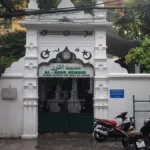
The nearest mosques we can recommend are in central Ho Chi Minh City: Saigon Central Mosque (66 Dong Du) and Al Rahim Mosque (45 Nam Ky Khoi Nghia). For restaurants back in the city, see our guide to halal food in Ho Chi Minh City.
Tips for Muslim Families, Women and Older Travellers
- Start early: leave Ho Chi Minh City by 7:00 to reach Tay Ninh by 11:30 with a stop on the way.
- Heat: the courtyard is hot at midday; bring water, a hat for outside and an umbrella.
- Stairs: the gallery is upstairs; older travellers can watch part of the ceremony from the side doors on the ground floor if staff allow.
- Children: explain beforehand that it is a place of worship and silence is expected during the ceremony.
- Toilets: facilities are on the grounds; carry tissues.
Getting There
| From | By | Time |
|---|---|---|
| Ho Chi Minh City centre | Private car | 2.5–3 hours (about 100 km) |
| Cu Chi Tunnels (Ben Dinh) | Private car | About 1.5 hours |
| Ba Den Mountain | Private car | About 20–30 minutes |
Location: Cao Dai Holy See on Google Maps.
Combine It With
- Cu Chi Tunnels, the wartime tunnel network on the way back to the city.
- Ba Den Mountain, the highest peak in southern Vietnam, with a cable car to the summit.
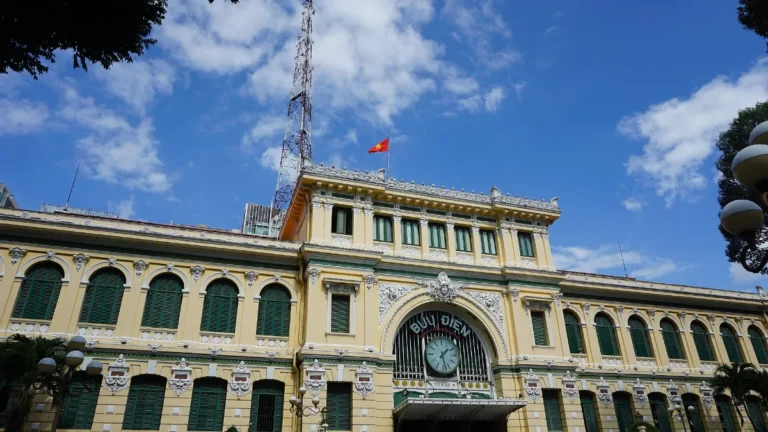
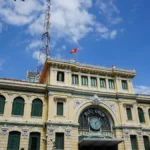
- More ideas in our Ho Chi Minh City attractions guide for Muslim travellers, including Independence Palace and the Saigon Central Post Office.
The easiest way to see it is our Cao Dai Temple and Cu Chi Tunnels Muslim tour (1 day): a private car and guide, timed for the noon ceremony, with your lunch arranged in advance. Every tour can be tailored, with a best price guarantee when you book direct; we usually reply within 24 hours.
Frequently Asked Questions about the Cao Dai Temple
1. Is there an entrance fee for the Cao Dai Temple in Tay Ninh?
No. Entry to the Holy See and to the noon ceremony gallery is free.
2. What time is the Cao Dai ceremony?
Ceremonies are held four times a day at 6:00, 12:00, 18:00 and 24:00. Visitors usually watch the 12:00 ceremony from the upper gallery.
3. How far is the Cao Dai Temple from Ho Chi Minh City?
About 100 km north-west, or 2.5 to 3 hours by car. Most visitors combine it with the Cu Chi Tunnels in one day.
4. Can Muslim visitors enter the Cao Dai Temple?
Yes. Visitors of all faiths are welcome as observers and are never asked to take part in rituals. Entering the hall is optional; you can also admire the temple from the courtyard.
5. What should I wear to the Cao Dai Temple?
Modest clothing that covers shoulders and knees. You remove your shoes and hat before entering the hall.
6. Is there halal food near the Cao Dai Temple?
There is no certified-halal restaurant near the temple that we can verify. On our tours we arrange a packed halal lunch from Ho Chi Minh City or vegetarian food, agreed with you in advance.
7. Can I take photos inside the Cao Dai Temple?
Photos are usually allowed without flash. Stay in visitor areas during the ceremony and avoid close-ups of people praying.
8. How long should I spend at the Cao Dai Temple?
About 1 to 1.5 hours, including the noon ceremony and a walk around the grounds.
Photo credits: Cao Dai Holy See, Tay Ninh: Rami Neudorfer / CC BY-SA 4.0 via Wikimedia Commons; Cao Dai Temple interior: Clay Gilliland / CC BY-SA 2.0 via Wikimedia Commons; Cao Dai Temple noon ceremony: Clay Gilliland / CC BY-SA 2.0 via Wikimedia Commons.
Updated 16 October 2026 by the Vietnam Muslim Tours team. Prices and opening hours are checked against official and recent local sources; they can change, so we re-confirm them for every guest before the tour.