Al-Noor Mosque Hanoi: The Only Mosque in Northern Vietnam – History, Ramadan & Tips for Muslim Travellers (2026)
Al-Noor Mosque (Thánh đường Hồi giáo Al-Noor), at 12 Hang Luoc Street in Hanoi’s Old Quarter, is the only mosque in Hanoi and in all of northern Vietnam. Indian Muslim merchants from Bombay raised the funds in 1885 and the mosque opened in 1890, so it has served the faithful for more than 135 years. Entry is free, the five daily prayers and Jumu’ah are held here, women have a separate prayer area, and halal food is available inside the grounds and on the surrounding streets. For Muslim travellers, holidaymakers and halal-conscious families visiting Vietnam, it is the one place in the north to pray in congregation and meet the local community.
Status (checked October 2026): active as normal for the five daily prayers and Friday Jumu’ah. There are no fixed visiting hours: the gate is generally open around prayer times. Ramadan 2027 is expected to begin around 8 February 2027 (subject to moon sighting), with a community iftar every evening.
Al-Noor Mosque: Quick Answers (2026)
| Address | 12 Hang Luoc Street, Hoan Kiem Ward, Hanoi (western side of the Old Quarter) |
|---|---|
| Entrance fee | Free; donations welcome |
| Open | Around the five daily prayers; busiest at midday Friday for Jumu’ah |
| Built | Funds raised in 1885 by Indian Muslim merchants; opened in 1890 |
| Capacity | About 200–300 worshippers |
| Women | Separate prayer section behind a curtain; hair covered inside |
| Wudu | Ablution taps next to the prayer hall |
| Dress code | Long sleeves, long trousers or skirt; shoes off in the prayer hall |
| Non-Muslim visitors | Welcome outside prayer times; ask the caretaker first |
| Halal food | A halal eatery inside the grounds and several halal restaurants within 5 minutes’ walk |
| Getting there | 15 minutes on foot from Hoan Kiem Lake; 40–60 minutes from Noi Bai Airport |
| Qibla in Hanoi | About 284° (west-north-west) |
Why Al-Noor Mosque Matters to Muslim Travellers
- The only mosque in the north: from Hanoi to Halong Bay, Ninh Binh and Sapa, Al-Noor is the one place where congregational prayer and Jumu’ah are held.
- A living piece of history: a 19th-century Indo-Islamic mosque that survived the wars and still stands among the guild streets of the Old Quarter.
- A small, welcoming ummah: Vietnamese Muslims, embassy families from Malaysia, Indonesia, the Gulf and South Asia, students and travellers pray side by side.
- Halal food on the doorstep: the densest cluster of halal and Muslim-run eateries in northern Vietnam is within a few minutes’ walk.
- Ramadan in Vietnam: the nightly community iftar is one of the warmest experiences a Muslim visitor can have in Hanoi.
History of Al-Noor Mosque
Indian merchants in 19th-century Hanoi
In the 19th century, merchants from India and the Middle East settled in Hanoi to trade fabric and exchange money, mainly around Hang Dao, the silk street of the Old Quarter. As Hanoi grew into a French colonial city, this small community needed a place to pray together. In 1885 Indian Muslims from Bombay (today’s Mumbai) raised the money to build a mosque on Hang Luoc Street, and it officially opened in 1890 under the name Al-Noor, “the Light”.
War, silence and revival (1964–1990s)
As most of the Indian traders left Vietnam in the mid-20th century, the community shrank to a handful of families. The mosque closed during the war years from 1964 to 1973; it was never hit by bombs. In the early 1990s, with support from diplomats of Muslim countries posted in Hanoi, regular prayers returned, and the building was restored to use. Read more on Wikipedia.
The community today
In December 2011 the Hanoi authorities recognised a management board for the mosque, and since then it has been run by Vietnamese Muslims. The local community numbers a few hundred believers, including Vietnamese converts and families of South Asian descent, while embassy staff, international students and Muslim tourists swell the congregation on Fridays and during Ramadan. In recent years the imam has come from the Cham Muslim community of Ninh Thuan in southern Vietnam. Learn more about the wider picture in our guide to Islam and Muslims in Vietnam.
Architecture: What to See at Al-Noor Mosque
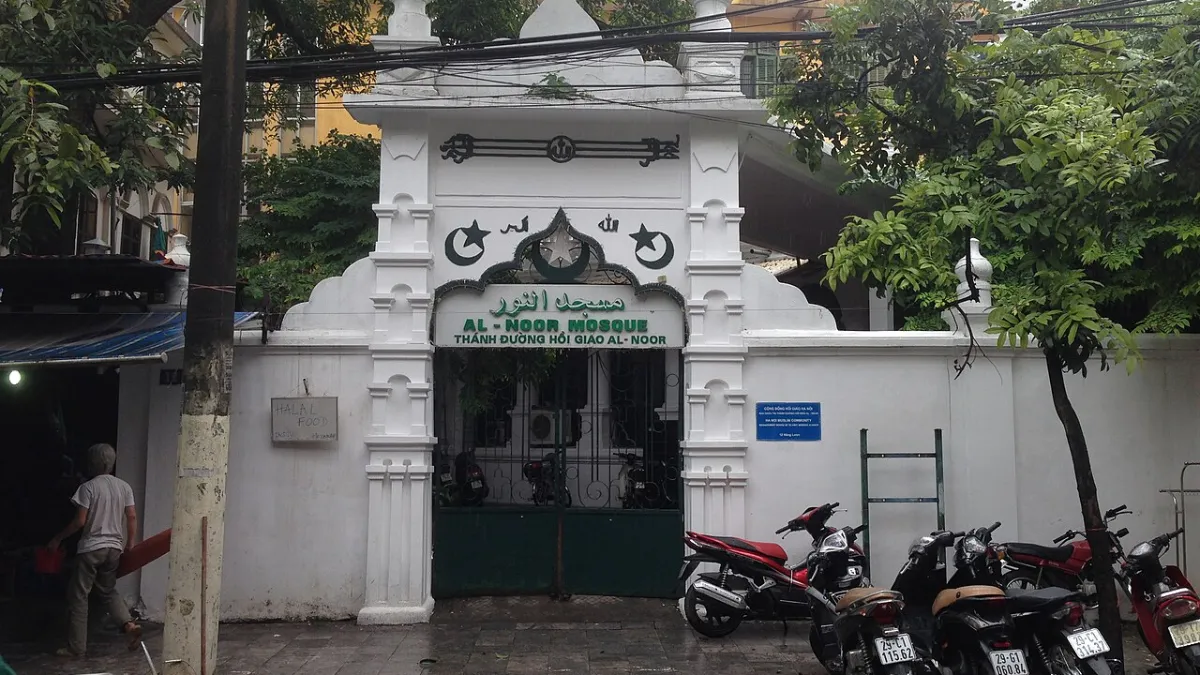
1. The street gate on Hang Luoc
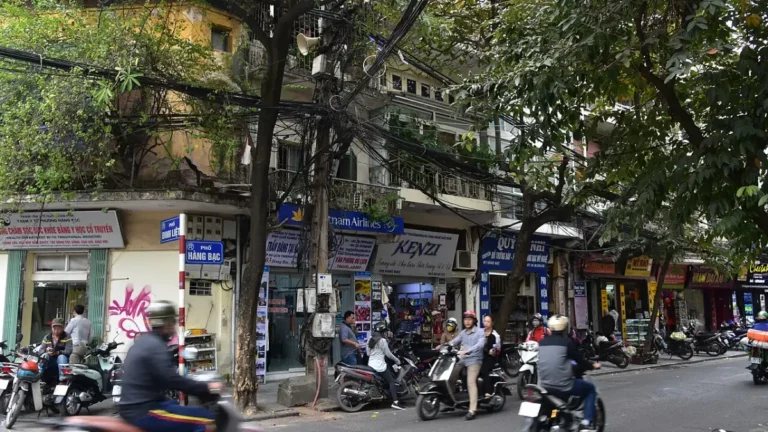
A white gate topped with a crescent and the mosque’s name in Arabic and English opens from the busy street into a quiet courtyard, a sudden calm after the motorbikes outside.
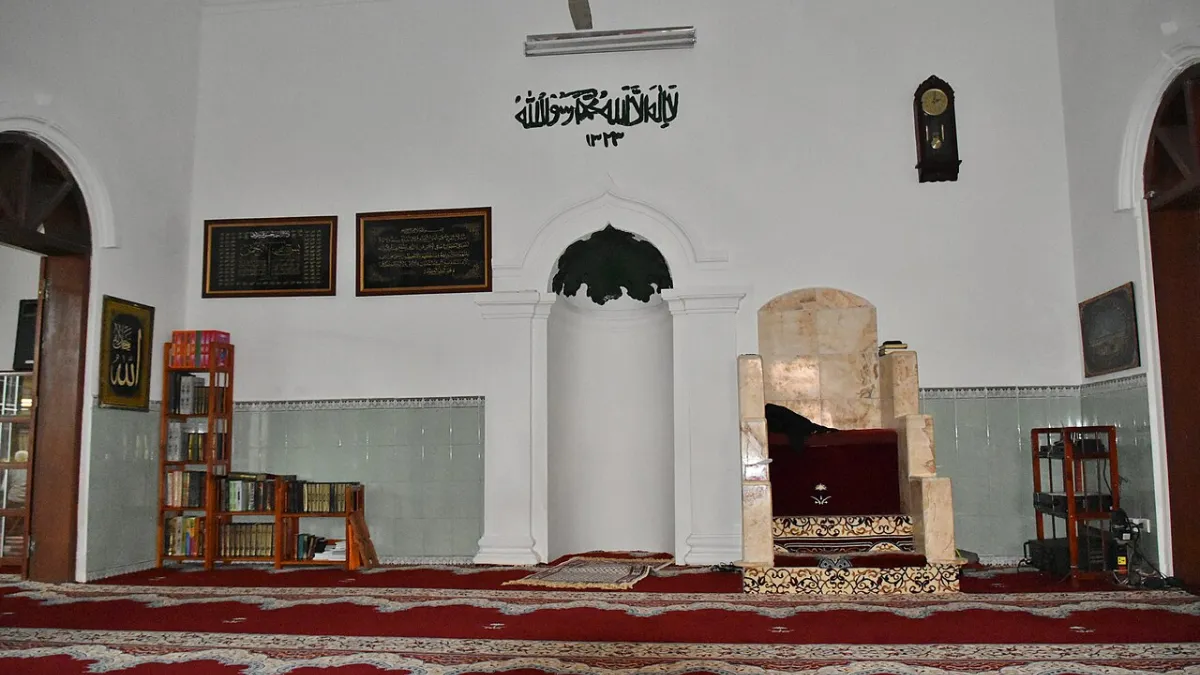
2. The prayer hall and its arches
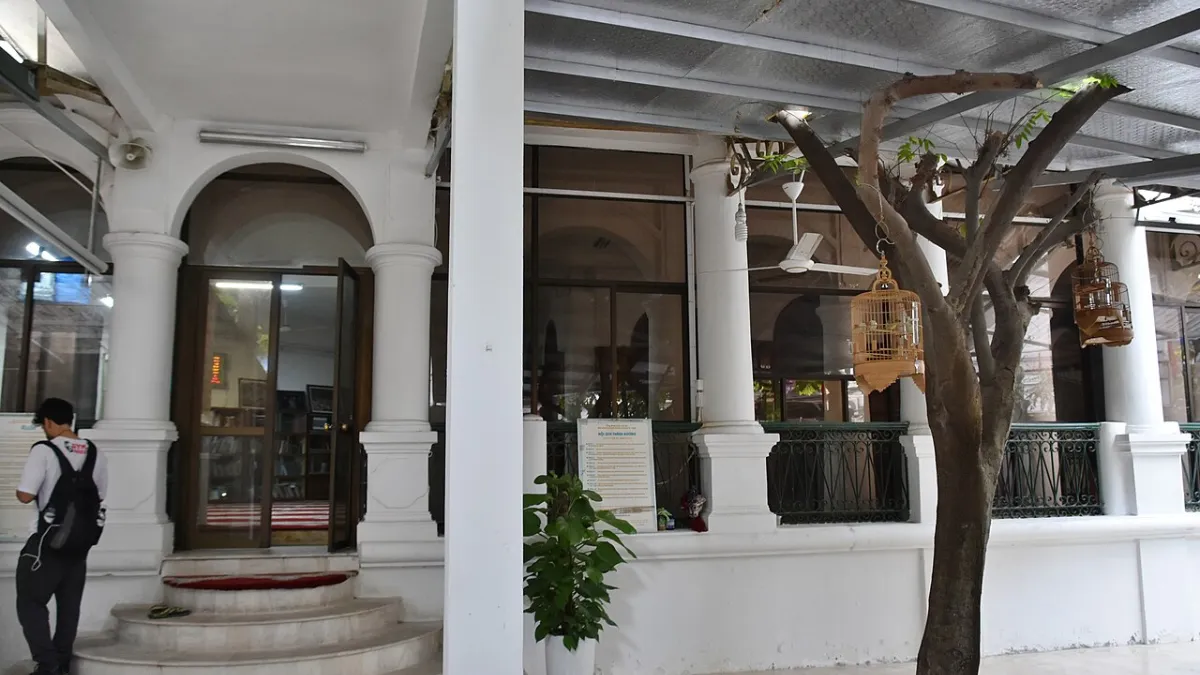
The whitewashed hall shows clear Indian influence: tall, wide arched openings, a columned veranda and decorative mouldings. Inside, red carpets face the mihrab, oriented west towards Makkah, beside a carved minbar used for the Friday khutbah. The hall holds about 200–300 worshippers.
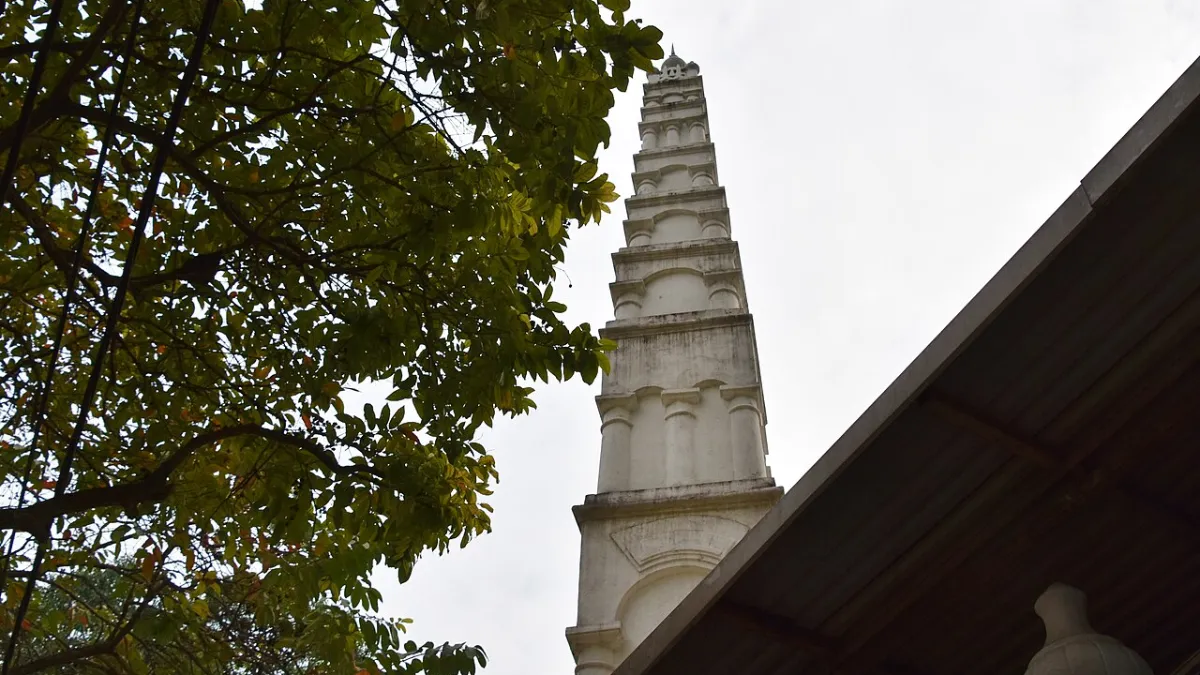
3. The minarets
Slender, tiered white minarets rise above the roofline, a silhouette found nowhere else in northern Vietnam and easy to spot from neighbouring streets.
4. The ablution area and courtyard
Beside the hall is a washroom with a row of taps for wudu. The courtyard doubles as a meeting place after prayers and as the dining area for iftar during Ramadan.
Prayer at Al-Noor Mosque: Jumu’ah, Daily Prayers and Etiquette
- Daily prayers: the five prayers are held in congregation; the gate usually opens shortly before each one.
- Jumu’ah: Friday midday is the busiest time of the week. Arrive early to find space; men often wear traditional dress.
- Women: pray in a separate area behind a curtain. Bring a light hijab or shawl if you do not normally wear one.
- Language: prayers are in Arabic; announcements may be in Vietnamese or English.
- Prayer times: they shift through the year; check a reliable prayer app for Hanoi on the day, and our guides plan sightseeing around the prayer you wish to attend.
Visiting Al-Noor Mosque: Rules for Muslim and Non-Muslim Visitors
- Dress modestly: long sleeves, long trousers or a long skirt; women cover their hair inside.
- Remove shoes before entering the prayer hall and keep voices low.
- Non-Muslim friends and family are welcome outside prayer times; ask the caretaker before entering the hall.
- Ask permission before taking photos of people or the interior, and never photograph during prayer.
- A donation box supports upkeep and the Ramadan iftar.
Ramadan at Al-Noor Mosque
Ramadan is the mosque’s busiest month. Each evening, a free community iftar is served in the courtyard, sponsored in turn by halal restaurants, embassies and families; in 2024 Vietnamese media reported around 300 people breaking their fast here daily with dates, biryani, chicken korma, beef kebab, lamb curry and naan. Local Muslims, expatriates and visiting Muslim tourists sit together, and some Vietnamese guests are invited to share the meal. Tarawih prayers follow. If your trip falls in Ramadan 2027 (expected from around 8 February 2027), ask us to time your Hanoi days so you can join an iftar here; see also Ramadan in Vietnam.
Halal Food Near Al-Noor Mosque
Hang Luoc and the streets around it form the main halal food corner of northern Vietnam. A few options within a five-minute walk, all checked by our team:
| Place | Address | Halal status | Map |
|---|---|---|---|
| Zaynab Restaurant | Inside the mosque grounds, 12 Hang Luoc | Halal (HalalGo certified) | map |
| Halal Banh Mi Raja Express | 29 Hang Luoc | Self-declared halal | map |
| Halal Food Abdul Karim | 2B Hang Khoai | Certified by Halal Medina UZK | map |
| Pho Muslim | 22 Dong Xuan | Halal (HalalGo certified) | map |
| Halal Food Station | 23 Hang Cot | Muslim-owned | map |
Note: some Indian restaurants on Hang Luoc use halal meat but serve beer and wine; if you prefer an alcohol-free table, choose one of the places above. For the full picture, read our guide to halal food in Hanoi.
How to Get to Al-Noor Mosque
| From | How | Time |
|---|---|---|
| Hoan Kiem Lake | Walk north via Hang Dao and Hang Ngang, then west to Hang Luoc | About 15 minutes |
| Old Quarter hotels | Walk | 2–15 minutes |
| Ho Chi Minh Mausoleum | Taxi or Grab (about 2 km) | About 10 minutes |
| Noi Bai Airport | Taxi or Grab; airport bus 86 to the Old Quarter | 40–60 minutes |
| Hanoi Railway Station | Taxi or Grab | About 10 minutes |
Find it on Google Maps. Taxi drivers know it as “Thánh đường Hồi giáo Hàng Lược”.
Praying Elsewhere in Vietnam
Because Al-Noor is the only mosque in the north, travellers heading to Halong Bay, Ninh Binh or Sapa pray at their hotel or on board; our guides help you find a clean, quiet place to pray, and some of the halal-certified Halong Bay cruises have a prayer room. Noi Bai International Airport has a prayer room in Terminal 2. In the south, Ho Chi Minh City has several mosques, including the Saigon Central Mosque on Dong Du Street, and the Mekong Delta around Chau Doc is home to Vietnam’s largest Cham Muslim communities; see our Chau Doc Cham Muslim village guide.
Plan a Muslim-Friendly Day Around Al-Noor Mosque
- Morning: Ho Chi Minh Mausoleum and the Temple of Literature.
- Midday: Dhuhr (or Jumu’ah on Friday) at Al-Noor, then a halal lunch next door.
- Afternoon: walk the Hanoi Old Quarter to Hoan Kiem Lake.
- Evening: Maghrib at the mosque, the water puppet show and a halal dinner.
Our Hanoi City Muslim Tour 1 Day follows this rhythm with a private guide and certified-halal meals, and our Hanoi Muslim tours come with a best price guarantee when you book direct. See the Hanoi Muslim travel guide or contact Vietnam Muslim Tours Team for a free custom itinerary; we usually reply within 24 hours.
Frequently Asked Questions about Al-Noor Mosque
1. Is Al-Noor the only mosque in Hanoi?
Yes. Al-Noor Mosque at 12 Hang Luoc Street is the only mosque in Hanoi and in the whole of northern Vietnam. The nearest other mosques are in the south, in Ho Chi Minh City and the Mekong Delta.
2. When was Al-Noor Mosque built?
Indian Muslim merchants from Bombay (now Mumbai) raised the funds in 1885, and the mosque officially opened in 1890, making it more than 135 years old.
3. Who built Al-Noor Mosque?
It was funded by the Indian Muslim community, traders who had settled in the textile and money-exchange streets around Hang Dao in the 19th century, together with merchants from the Middle East.
4. Is there an entrance fee at Al-Noor Mosque?
No. Entry is free. Donations towards upkeep and the Ramadan iftar are welcome and can be given to the caretakers.
5. When is Al-Noor Mosque open?
The gate is usually open around the five daily prayers and is busiest at midday on Fridays for Jumu’ah. There are no fixed visiting hours, so non-Muslim companions should come outside prayer times and ask the caretaker first.
6. Can women pray at Al-Noor Mosque?
Yes. Women pray in a separate section screened by a curtain. Sisters should cover their hair inside the mosque; a hijab or shawl is enough.
7. Can non-Muslims visit Al-Noor Mosque?
Yes, respectfully and outside prayer times. Dress modestly (long sleeves and trousers or a long skirt), women cover their hair, remove shoes before the prayer hall and ask before taking photos.
8. Is there a place for wudu at Al-Noor Mosque?
Yes. The mosque has a washroom with a row of taps for ablution (wudu) next to the prayer hall.
9. Is there halal food near Al-Noor Mosque?
Yes. A small halal eatery operates inside the mosque grounds, and several halal and Muslim-run restaurants are within a few minutes’ walk, including halal banh mi on Hang Luoc Street, a Halal Medina UZK-certified kitchen on Hang Khoai and a halal pho shop on Dong Xuan Street. Some Indian restaurants on Hang Luoc use halal meat but serve alcohol, so check before you sit down.
10. What happens at Al-Noor Mosque during Ramadan?
Every evening of Ramadan the mosque hosts a free iftar, sponsored in turn by halal restaurants, embassies and community members. In 2024 local press reported around 300 people breaking their fast there each day, with dishes such as biryani, korma, kebab and dates.
11. When is Ramadan 2027 in Hanoi?
Ramadan 1448 AH is expected to begin around 8 February 2027 and Eid al-Fitr around 9–10 March 2027, depending on the sighting of the moon. Our team confirms the dates with the mosque community each year.
12. Which direction is the qibla in Hanoi?
The qibla from Hanoi is roughly west-north-west, about 284° from true north. The mosque itself is aligned towards Makkah.
13. How do I get to Al-Noor Mosque?
It is on Hang Luoc Street on the western side of the Old Quarter: about 15 minutes on foot from Hoan Kiem Lake, 5 minutes by taxi or Grab, and 40–60 minutes from Noi Bai Airport.
14. Can I attend Friday prayer at Al-Noor Mosque as a tourist?
Yes. Muslim travellers are welcome at Jumu’ah, which is held at midday. Arrive early, as the prayer hall fills with local worshippers, diplomats and students.
15. Is Al-Noor Mosque worth visiting?
Yes. For Muslim travellers it is the spiritual home of Islam in northern Vietnam, a 19th-century Indo-Islamic building in the heart of the Old Quarter, and the best place to meet the small, welcoming local community.
Photo credits – Al-Noor Mosque Gate, 12 Hang Luoc: RG72 / CC BY-SA 3.0 via Wikimedia Commons; Al-Noor Mosque Prayer Hall Exterior: Richard Mortel from Riyadh, Saudi Arabia / CC BY 2.0 via Wikimedia Commons; Al-Noor Mosque Mihrab and Minbar: Richard Mortel from Riyadh, Saudi Arabia / CC BY 2.0 via Wikimedia Commons; Al-Noor Mosque Minaret: Richard Mortel from Riyadh, Saudi Arabia / CC BY 2.0 via Wikimedia Commons.
Updated 16 October 2026 by the Vietnam Muslim Tours team in Hanoi. Opening hours and prices are checked against official notices; they can change, so we re-confirm them for every guest before the tour.